
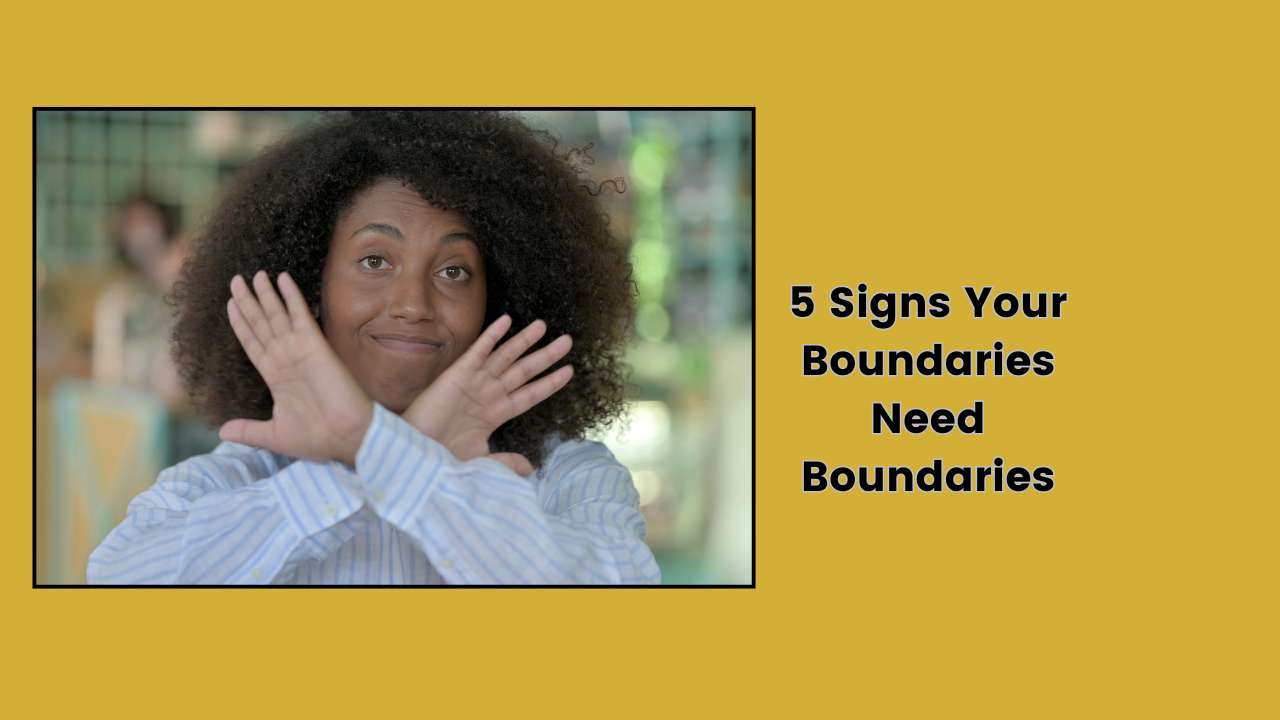
I used to think that setting boundaries meant I'd finally figured it out.
I'd learned to say no. I stopped saying yes to everything. I became more aware of my time, my energy and what I needed. On paper, it looked like I had healthy boundaries.
But if I'm honest with you, something still didn't feel right.
I realised I was setting boundaries... and then immediately feeling guilty for having them.
I'd say no, then spend the next three days wondering if I'd upset someone. I'd protect my peace, then feel responsible for someone else's disappointment. I'd finally choose myself, only to question whether I'd been selfish.
That's when I realised something.
"Sometimes our boundaries still need boundaries."
Because a boundary isn't just something we communicate to other people. It's also something we protect within ourselves.
If every boundary you set is followed by guilt, overthinking or an overwhelming urge to rescue someone from the consequences of your decision, then perhaps the boundary hasn't quite reached your heart yet.
Five Signs Your Boundaries Need Boundaries
1. You explain your boundary more than you honour it.
Have you ever noticed how a simple "No, I can't make it" suddenly turns into a five-minute explanation? You provide context. You justify yourself. You soften the message. You reassure the other person that you're still kind, caring and thoughtful.
Boundaries don't require a courtroom defence. Sometimes the most loving thing you can do is trust that your "no" is enough.
2. You feel guilty every time you choose yourself.
Choosing yourself shouldn't feel like you've done something wrong. But when you've spent years believing your value comes from being useful, guilt often appears the moment you stop overgiving.
The guilt isn't proof you've made the wrong decision. It's often proof you're doing something unfamiliar.
3. You're more uncomfortable with someone else's disappointment than your own exhaustion.
Read that again.
How many times have you sacrificed your own wellbeing because you couldn't bear the thought of someone being upset with you?
Eventually, somebody is always disappointed. The question is simply this: Will it be them... or will it continue to be you?
4. You keep reopening doors you've already closed.
You set the boundary. Someone pushes back. They become upset. Perhaps they become silent. Perhaps they become angry. And before long, you're negotiating with your own decision.
Not because the boundary was wrong. Because their reaction made you uncomfortable.
Healthy boundaries don't become unhealthy simply because someone doesn't like them.
5. You're protecting everyone else's peace except your own.
This one stopped me in my tracks.
I realised I was working incredibly hard to make sure everybody else felt comfortable. Meanwhile, I was carrying stress, resentment and emotional exhaustion that nobody else could see.
Peace isn't something we're only meant to create for other people. We're allowed to experience it ourselves.
Why This Happens
Most of us weren't taught that boundaries were healthy. We were taught to be helpful. To be polite. To be accommodating. To avoid conflict. To keep the peace.
If you've experienced childhood trauma, emotional neglect or environments where love felt conditional, it's understandable that boundaries might feel uncomfortable. Somewhere along the way, you may have learned that keeping other people happy kept you safe.
That belief doesn't disappear simply because you learn the word "boundary." Healing asks us to gently challenge the belief beneath the behaviour.
The Hidden Cost
When your boundaries constantly bend, so does your identity.
You begin making decisions based on how they'll affect everyone else rather than what feels true for you. You lose confidence in your own judgement. You stop trusting your intuition. You become emotionally tired without understanding why.
Over time, the greatest cost isn't simply burnout. It's forgetting that your life belongs to you.
What Changes When You Begin Choosing Yourself?
Something remarkable happens when your boundaries become rooted in self-respect instead of guilt.
You stop needing everybody to understand your decisions. You stop explaining yourself quite so much. You begin trusting that disappointing someone occasionally is healthier than disappointing yourself every single day.
And perhaps the most beautiful shift of all?
You begin hearing your own voice again.
Not the voice of obligation. Not the voice of fear. Not the voice that asks, "What will everyone else think?"
Your voice.
The one that's been waiting patiently beneath years of conditioning.
Coming Home
I've come to believe that boundaries aren't walls. They're invitations.
They invite healthier relationships. They invite honesty. They invite self-respect. Most importantly, they invite you back into your own life.
Because every time you honour a boundary, you're quietly saying something to yourself.
"My needs matter too."
And for many women, that simple sentence is where freedom begins.
A Final Reflection
Perhaps the goal was never to become better at saying no.
Perhaps the goal has always been to become the kind of woman who no longer needs permission to honour herself.
Because when your boundaries stop existing to manage other people's reactions and start existing to protect your own peace...
Everything changes.
And maybe that's the quiet invitation waiting beneath every boundary you've ever been afraid to set.
Not distance.
Freedom.